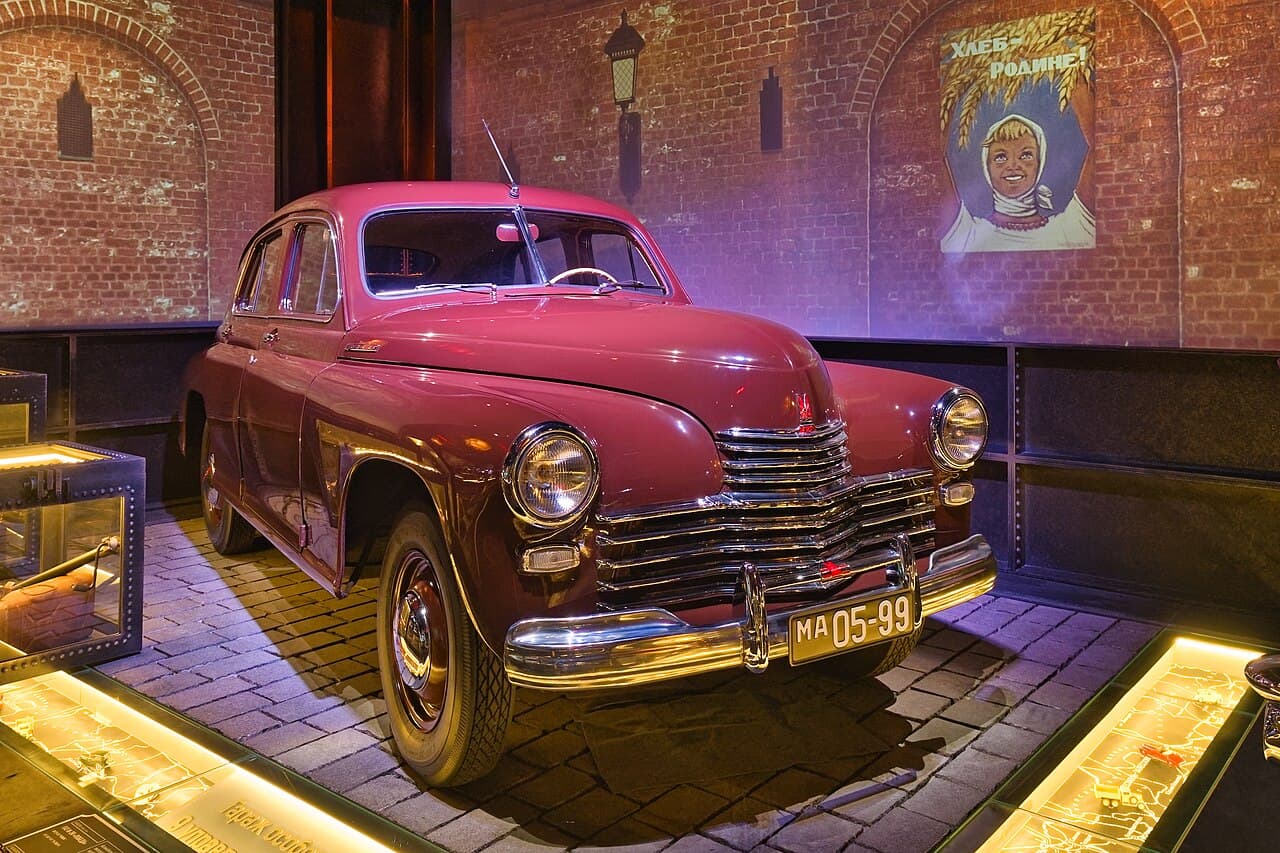
GAZ-M20 Pobeda
History
One of the world's first production cars with a full-width body and no separate wings. A symbol of post-war recovery, named after the victory in the Second World War.
Work on the Pobeda began in 1943, in the middle of the war, when a team at GAZ led by Andrei Lipgart was told to design a completely new car. Its working name was “Rodina” (Motherland), but legend has it that Stalin, on hearing the question “and how much will we sell the Motherland for?”, chose “Pobeda” — Victory. It was one of the first production cars anywhere with a full-width body free of protruding wings. The car was widely exported and built under licence in Poland as the Warszawa.
Production
- Production years
- 1946–1958
- Total built
- 235,999 units
- Price
- 16,000 roubles
- Designer
- Andrei Lipgart
Specifications
- Engine
- 2112 cc, 4 cyl.
- Power
- 52 hp
- Top speed
- 105 km/h
- 0–100 km/h
- 46 s
- Gearbox
- 3-speed
- Drive
- Rear
- Weight
- 1460 kg
- Fuel consumption
- 11 l/100 km
Data sheet
- Production period
- 1946–1958
- Dimensions (L × W × H)
- 4665 × 1695 × 1640 mm
- Seats
- 5
- Kerb weight
- 1460 kg
- Gross weight
- 1835 kg
- Wheelbase
- 2700 mm
- Ground clearance
- 200 mm
- Top speed
- 105 km/h
- Fuel consumption
- 11 l/100 km
- Engine
- M-20, carburettor, four-stroke, four-cylinder, side-valve
- Displacement
- 2.12 l
- Compression ratio
- 6.2
- Maximum power
- 52 hp
- Clutch
- single-plate, dry, semi-centrifugal
- Gearbox
- three-speed
- Final drive
- single, bevel, with spiral teeth
- Steering gear
- globoid worm and twin-ridge roller
- Tyre size
- 6,00-16
Source: the autoussr.ru reference archive
One of the first production cars with a full-width “pontoon” body
Stalin personally approved the name Pobeda
Built in Poland as the Warszawa until 1973
An average wage in the 1950s was 700 roubles; the car cost 16,000
The GAZ-M72 four-wheel-drive version was built for rural roads